
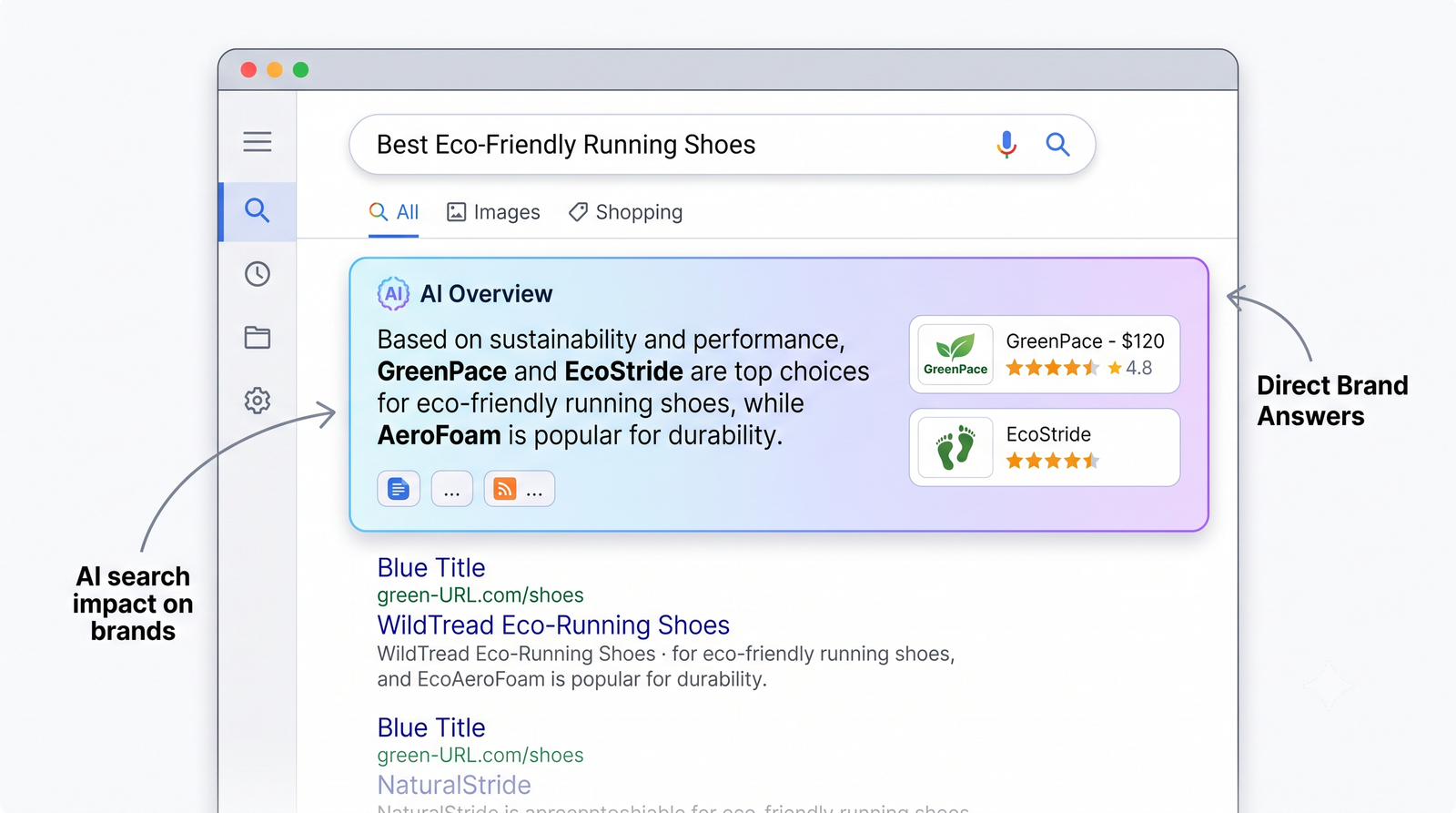
Search results no longer look the way they did two years ago. Google now places AI-generated answers above the links. That shift is the impact of AI search on brands since indexing.
Many articles say you must reinvent your SEO strategy overnight. I disagree. Here is what is actually changing what is not and how I approach it.
What Is Changing in Google Search?
Google AI Overviews answer a question directly on the results page. Users often get what they need without clicking anything.
For brands that creates two effects at once:
- Fewer clicks on some queries. A page can rank well. Still get traffic if the AI answer covers the basics.
- New visibility opportunities. Clear trustworthy pages can be cited as sources inside the answer.
Research backs up the click concern. A Pew Research Center analysis found that users clicked results often when an AI summary appeared. So the worry is real. The AI summary is not the end of search.
The Impact of AI Search on Brands: Risk and Opportunity
Think of Google AI Overviews brand visibility as a layer on top of rankings. You can now be visible in two ways: as a ranked link and as a cited source.
Traditional Search AI-Powered Search Main goal Rank and earn the click Be cited and trusted Key Rankings clicks Clicks, impressions citations Content that wins Relevant, optimized pages structured pages Biggest risk Losing rank Losing clicks despite ranking The skills behind both columns overlap heavily. That is why I don’t call this a discipline.
The Biggest Mistake Brands Make
The common mistake I see is panic. Brands read a headline. Start chasing AI- tricks. They publish content in bulk. They rewrite pages that were already performing.
This usually backfires for three reasons:
- Bulk content is generic and generic content rarely earns citations.
- Rewriting everything at once makes it impossible to see what worked.
- Pages that ranked well may lose that ranking after a rewrite.
Is Generative Engine Optimization for Brands a New Skill?
You will see the term engine optimization for brands now. It describes making your content more likely to appear in AI-generated answers.
Here is my honest view. Most of engine optimization for brands is SEO with a label. Google’s own guidance on AI features says the same fundamentals apply: content, crawlable pages and a good user experience.
The new part is measurement. You now have to watch whether your brand appears in AI answers and the tools for that are still immature.
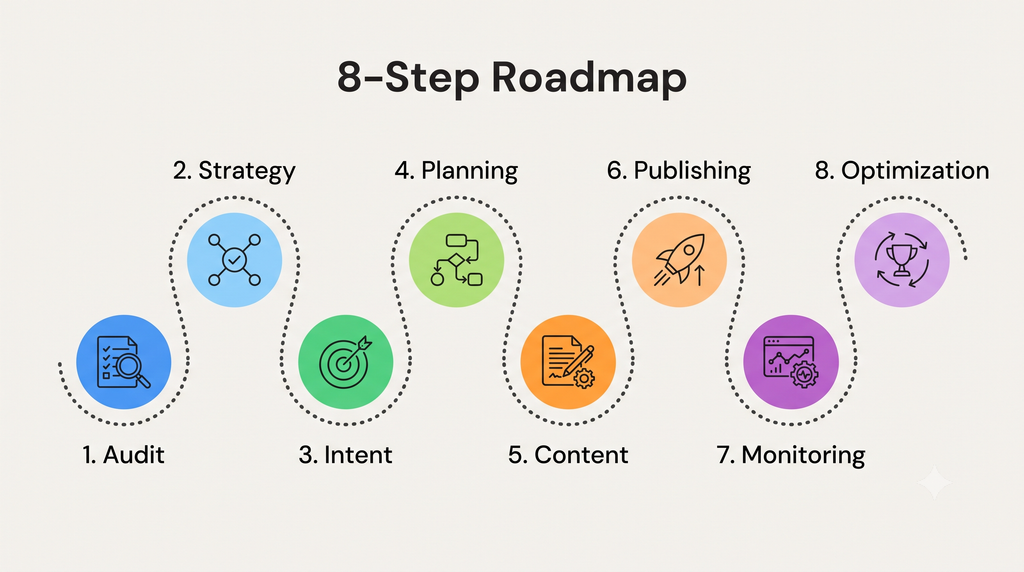
My 8-Step Process When a Brand Worries About AI Search
This process builds on what works of replacing it.
Step 1: Audit Current SEO Performance
Open Google Search Console and Google Analytics. Review traffic, impressions, click-through rates, rankings and conversions. Find which pages perform well and where visibility or traffic is slipping.
Step 2: Understand Audience and Search Intent
Look at what people ask and which problems they want solved. Don’t chase high-volume keywords. A smaller question that your audience truly cares about converts better.
Step 3: Analyze the Search Results
Search your topics. Study what appears. Check AI Overviews where featured snippets, People Also Ask boxes and competing pages. Note which sources get referenced and what gaps exist.
Step 4: Improve Content Quality and Credibility
Write content thats new, true and useful. Answer questions in a way. Give examples. Show that you know the topic well and back up points with sources. Do not write pieces just to increase word count.
Step 5: Strengthen Your SEO Foundations
Look over SEO, page speed, mobile friendliness, internal links, structured data and crawlability. Make the important information easy for both readers and search engines to read.
Step 6: Build Topical Authority and Brand Trust
Do not publish posts that focus on keywords. Create content that centers on your brand’s expertise. Earn backlinks, industry mentions and reviews. These signals help build your reputation.
Step 7: Monitor AI Visibility Alongside SEO
Track clicks, impressions, rankings, conversions and engagement. When you can check if your brand or content shows up in answers.
One honest limitation: AI Overview visibility is not a metric in reporting tools. Treat it as one piece of a picture never the measure of success.
Step 8: Test, Learn and Improve
Look at the results. Change one element at a time. If a page gets impressions. Few clicks ask if the search intent, the title, the content or a change in the results page is responsible. Make a fix then measure again.
A service business has a guide page that gets impressions but a low click‑through rate. After looking at the results page you notice an AI Overview answering the question. Rather than rewrite the guide add a title, a specific example and original advice that the Overview does not provide. Then observe the click‑through rate for a weeks.
Want help running this audit for your site?
Common Questions About Brands and AI Search
Do brands need to abandon SEO?
No. Seo, content, search intent, usability and brand credibility still drive rankings and citations.
Can I track my brand in Google AI Overviews?
partially. Standard reporting tools do not show AI Overview visibility as its metric so combine Search Console data with checks of your queries.
Should I publish content to appear in AI answers?
Not just for volume. Original, accurate, expert content attracts attention. Repetitive articles dilute your authority.
Does this advice work for every brand?
Not always. Results differ by industry, query type and how often AI answers appear for your topics. Test with your data before making changes.
Evolve Don’t Panic
The impact of AI search on brands is real. It is an evolution, not a reset. Keep your fundamentals study how your topics appear in AI answers and make improvements.
Start this week with step one. Pull your Search Console data. Find pages that have impressions but low clicks. That list shows where to begin.
Need a pair of eyes on your results?
External references (do-follow). Please verify each URL. Statistic before publishing:
- Google Search Central “AI features and your website”: https://developers.google.com/search/docs/appearance/ai-features
- Pew Research Center, study on AI summaries. Click behavior: https://www.pewresearch.org/short-reads/2025/07/22/google-users-are-less-likely-to-click-on-links-when-an-ai-summary-appears-in-the-results/
- Google Search Central, “Creating people- content”: https://developers.google.com/search/docs/fundamentals/creating-helpful-content